
‘“You have a new message,” Siri announced via CarPlay.
”It said: ‘Can you talk? I need help.’
Would you like to reply?”
I was crossing the Golden Gate Bridge from my office in the city and on my way to a meeting in Mill Valley. The message was from a client of mine who had been part of our membership program for the past two years.
I called her and she picked up.
“Hey. How is it going?” I asked.
“Omar, I am in deep trouble. I have been contemplating suicide for the past two hours and I am considering taking action, and I don’t know what to do…” her voice trailed away “I need help, it is so painful..I want it to stop”.
If you're having thoughts of self-harm or suicide: call, text 988, or start a live chat with Suicide & Crisis Lifeline. It's free and confidential. You'll reach someone who is trained to listen and support you.
When a nervous system catches fire
She was weeping, and I…was wondering if I was a little over my skis here. It was sounding like more of a call she needed to have with her emergency psychiatrist, not her functional medicine coach.
However, I knew this person’s medical, family, and psychological history. I knew that she had a rough upbringing and a history of trauma and physical abuse that we had explored during the program.
I also had two years worth of lab tests and knew that her inflammatory markers were higher than her baseline.
And it was no surprise that she was inflamed, because it had been an extraordinarily stressful time for her. She had gone through a divorce when we first met, and a year later changed jobs, then six months ago moved to a new home, and her body was catching up with all these changes showing a lot of inflammation in the bloodwork and she reported many body aches.
This is all helpful information post crisis, and I felt responsible to show up for her. I just wanted to make sure she got the medical attention she needed.
“What is going on?” I asked.
“I went and visited my ex-husband, I wanted to apologize, and instead he did not let me into his house because his girlfriend was there and I felt so humiliated. I just want to fix it, I just want to apologize and fix it…” she trailed off to more crying. “Or I just want to end this pain…”
You can’t save anyone, I always remind myself in this job.
“I see.” I said. “What are you hoping to get right now?”
“I don’t know..I don’t know…it is so painful…” she said
…and then the network cut off!
Shit. Shit. Shit.
I pressed the pedal harder to get to the location faster.
It took 15 minutes to get there, and I called her immediately, but she did not pick up.
Shit!
I sent her messages on all the different platforms we were connected on. No response.
I called her again.
Nothing.
Fuck!
Corrosive thoughts dripped down my body like acid rain.
What if she did something to herself? I should have just parked on the side after the bridge? How selfish of me to get into the meeting rather than give her my full attention. What if she hurts herself? Would it be my fault? Will my insurance cover me? I fucked up! This is the end of my career! I needed to call 911 immediately and send them to her house!
Obsessive. Corrosive. Thoughts.
I was the inflamed one now.
Emotional Contagion
“Omar, you look like a royal mess!” the person I had the meeting with lovingly told me, as she placed a glass of water on the table in front of me. I told her what was happening, and after I failed to get a hold of my client, we started our meeting.
I checked my phone obsessively over and over again, until my colleague stopped our discussion (during which I had not listened to a single word. I was too busy doing the important work of imagining the worst possible scenario my client might be experiencing).
My colleague stopped talking, turned off her laptop, looked me in the eye, put a hand on my shoulder and said:
“Ok listen to me. When your client reach out, did you do your part and show up for her?”
“I don’t know if I did enough” I said.
“Well I see that you called her, you are making yourself available even when you weren’t, and at this point she has to show up for herself now. She is responsible for herself as well. You know where your role ends and where hers begins.” She said.
She was reminding me of what I always try to remind myself of, and keep forgetting. It is one thing to tell ourselves something, and another to be witnessed by another human that helps us zoom out of our myopic brains.
I relaxed.
While I was still worried about my client, that worry was now separated from my neurosis of beating myself up for someone else’s experience. I could now tap into my own deeper well of compassion for both myself and my client without over-identifying with her.
“Perhaps instead of worrying you should send her a text asking her what she needs?” my colleague asked.
Her words were balm to my nervous system.
That is when it hit me: I am trying to please my client, and therefore I am losing my own sense of regulation, rather than being a grounded presence for her. I am frying my own nervous system, as a result of interacting with hers. That is what I teach my clients, and yet I am such a lousy student myself! This stuff is not easy in practice.
I texted the client again “Please let me know that you are ok, and if you would like to get on the phone.”
After a couple of hours she replied back “I checked myself into the Stanford ER, I will let you know as soon as I am out.”
I was back to feeling like myself again, and went about my day, still curious and wondering how she is, but not blended with her reality, and no longer seeking a sense of validation from her.
I had inflamed my own system, in response to hers, and that is extremely common in all medical provision jobs.
Inflammation can spread virally that way.
“I just want it to stop”
Six hours passed before I heard back from my client that she had left the ER and was back home
She texted back saying that the physician found that the Thyroid Stimulating Hormone (TSH) was extremely high due to her being off her thyroid medications for a while. They attributed that to the severe mood swings she had resulting in that moment of suicidal ideation.
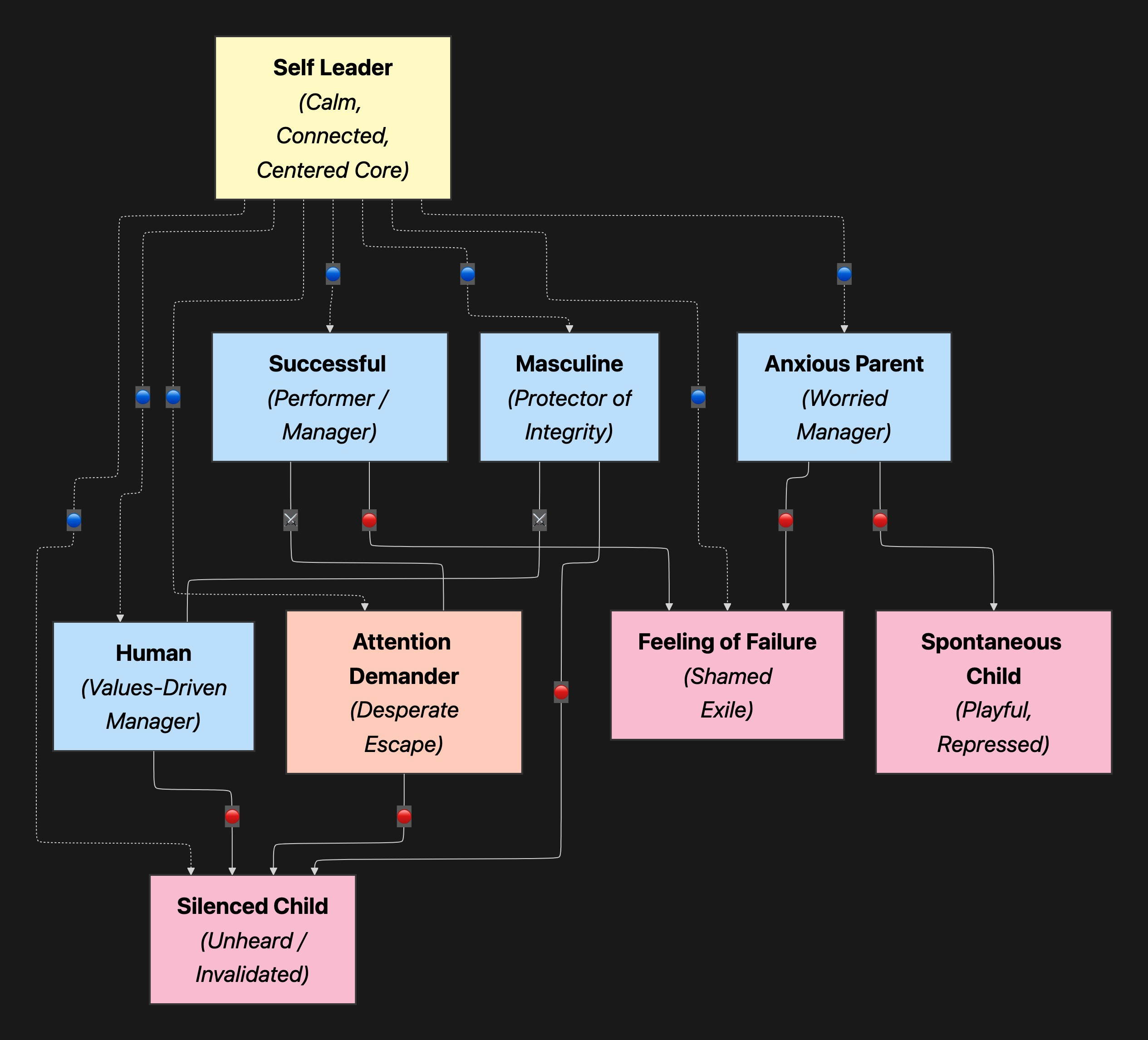
While the hormonal component offered a clue, there was still much more to be uncovered in the story. I was better prepared this time by studying her records and reminding myself of the mental model we had scoped together.
We each have our own version of this.
She finally had sometime to rest, and so did I.
We spoke two days later
She started by sharing what she had been through the past few days, and how the original trigger was when a coworker of hers calling her “rude” after she was voicing a concern that resulted in backlash.
I asked her what had come up after that challenging interaction at work.
She said, “It reminded me of everything my son and my ex have said to me over the years—that I’m rude, that my tone is condescending. It hurts every time. Not just because of what they say, but because I don’t think that’s who I am. People assume it’s my personality, but they don’t see my intention. And then I get defensive, and it spirals.”
She had reached out to her ex to apologize, she told me. “I wrote to him, but I think he misunderstood the way I said things. I was trying to take accountability, but I also wanted to be honest that he played a part too. That didn’t go well. So I drove to his house. I thought maybe face-to-face it would be better. But he didn’t want to talk. His girlfriend was there. He told me to leave.”
I asked what happened next.
“I got in my car and drove to the cemetery near his house,” she said. “I go there sometimes when I’m overwhelmed. I parked, and I just broke down. I couldn’t stop crying. The pain was unbearable. And all I could think was, ‘I can’t do this anymore.’”
I gently asked what that part of her—the one that wanted to end everything—wanted in that moment.
“It just wanted the pain to stop,” she said. “That’s it. Not to hurt anyone. Just to stop the pain.”
“And what would have eased the pain?” I asked.
“A call,” she said without hesitation. “Just a call from him saying, ‘I hear you.’ Even if he didn’t forgive me. Even if he said ‘but…’ after. I just wanted to be heard.”
I invited her to go back to that version of herself in the car—to be with her—and asked what she noticed.
“She’s drowning,” she said. “It’s not just about the breakup. It’s about years of not being heard. And she doesn’t know any other way to be noticed except to break down.”
I asked her what this part believed would happen if she wasn’t heard.
“She’d disappear,” she said. “She’d always be alone. The pain would just swallow her whole.”
“And what’s your relationship to her right now?” I asked.
“I’m not judging her,” she said. “Not today. I get why she’s there. I just wish she didn’t feel she had to go so far just to be seen.”
“If you could tell her something now, what would it be?” I asked.
“That I see her,” she said. “That I’m here. She doesn’t have to yell or scream anymore. I’ll listen.”
I asked her if she could use her hands to touch her chest to calm herself down, and if that suicidal part of her could receive that.
“Yes,” she said quietly. “For the first time, she’s calming down. I put my hand on my heart like we did before. And I felt something soften.”
We sat in that space for a moment, and then I asked, “Does this feeling—this fear of not being heard—remind you of something earlier in your life?”
She nodded. “Yeah. I can’t remember a specific moment, but it’s always been there. I grew up in a family that doesn’t do emotions. If you show vulnerability, you get yelled at. No comfort. No soothing. Just yelling. I think I learned to cry louder, to demand attention, just to be noticed.”
“And how did people respond?”
“With punishment,” she said. “I got smacked a lot for yelling or being too much. So I learned two things: one, people won’t hear me unless I’m loud. Two, being loud makes them hurt me. That contradiction has stayed with me.”
I asked if we could go to the child version of her for a moment. “Where is she now?”
“She’s in our old house,” she said. “There are people around, but no one’s paying attention to her. She feels invisible.”
“Is she aware of your presence now?” I asked.
“Yes,” she said. “She sees me.”
“And how would she like you to be with her?”
“Gently. Just being there is enough. Maybe holding her. Not saying much.”
I encouraged her to offer that.
“I’m with her now,” she said. “I just put my hand on her shoulder in my mind. She looks at me like she wants to believe I’ll stay.”
“Can you let her know you’re here for her?” I asked. “That she doesn’t have to scream to be seen anymore. That she has you.”
“She’s calming down again,” she said. “I think she believes me.”
“That’s beautiful,” I said. “If there’s one message she needed to hear most from you today, what would it be?”
“That she makes sense,” she said. “That her feelings make sense. And that I will not punish her for having them.”
We sat in silence for a moment, holding space for that truth to land.
Next week (Part 2/2), we’ll cover:
Why inflammation isn’t the enemy
How to measure it and the difference between internal vs external causes
What actually lowers it (and what’s wellness bs)
How to tell when you need medical care vs when you need to leave what’s inflaming you
If you are looking to try more effective ways of building habits that last, try out this free assessment to learn how you can meet yourself where you are at.
This is very interesting and thank you for sharing it.
It intersects with our research on inflammatory response cause-and-effect modeling.
Relating to this article, here is a very informative presentation by Dr. Andrew Miller at UCSF on the effects of pro inflammatory cytokines causing depression, anxiety and other mental issues:
https://youtu.be/570upjCb6lk?si=6HV4qW-oXyfCJIFd