
What do Maradona, Whitney Houston, Charlie Sheen, Jerry Garcia and Andre Agassi all have in common?
Today we will be discussing the uncomfortable topic of addictive behaviors, and — as always — I will share a part of my own struggles with you, alongside the research, what it says, and how to implement it towards higher levels of gumption.
The blockbuster names I mentioned above are amongst a long list of wildly ambitious people who suffered from addiction at the zenith of their success. Some may say they gave it all away, but those who understand trauma would recognize that those idols suffered silently beneath the veneer of their achievements. They carried the expectations of whole nations, and they never learned how to do so without self harm.
In a wicked way, addiction had become their most loyal friend.
Such is the fate of many (but not all!) high-achievers. Yes I am looking at you, dear reader. You and I may not suffer the burden of Maradona or Whitney, but the success we yearn for is only one side of the coin. On the other side, are all of our addictive behaviors, engraved.
I am not talking about a homeless guy doing heroin in a dark alley.
I am talking about the five cookies you eat when no one is looking.
The edible you consume while doing boring tasks.
The two beers you drink alone at the end of a workday.
The porn you watch in the middle of a work session to release tension.
The 45 minutes of doomscrolling to overcome your feelings of loneliness.
The Claude chat you are constantly multitasking with to feel productive.
You’re not alone. Pubmed research from the Minnesota Twin studies indicates that highly intelligent people may feel more prone to using substances due to sensation-seeking tendencies, boredom, or the desire to enhance focus.
Today I present you with:
My own story with addiction
The research behind substitute addiction and what we miss
What lies underneath addiction
Research-backed framework and a worksheet for how to implement it
(for paid readers, but if you leave a comment sharing your own story and struggles I will send you the worksheet.)
Welcome to another edition of In Search of Gumption — my messy kitchen where I lay my soul bare for you to witness as I build The Human Dash, a coaching program designed to help you achieve your dreams using data-driven stress-busting techniques. You can also check out my video essays and podcast, The Human Recovery Lab, on YouTube, Spotify, or Apple Podcasts.
So, I'm breaking the habit…I'm breaking the habit tonight
“Memories consume
Like opening the wound
I'm picking me apart again”Breaking the Habit — Linkin Park (Linkin Park lyrics make more sense the older I get).
Hello, my name is Omar Shaker and I am a highly-functioning human with big dreams and terribly addictive tendencies.
There are essays I can write in a single morning and publish, and others that I must grapple with for months/years until I am ready to share. Today’s piece is firmly in the latter category.
I have written about my struggle with cannabis and tobacco, and if you are an OG gumption reader, then you will remember my year-long cutting out of weed in 2024 and my valiant (and naive) attempt to replace it with Vipassana meditation. That cute experiment lasted for eight months, when that summer found me crumbling under financial worries and social isolation that forced me back to my old friend Mary Jay. Puff. Puff. Cough. Forget.
Today I am back in the arena, facing myself, albeit with a few bruises and a couple of relapses to my name.
They say it takes
- 5-30 attempts to quit smoking for good
- 2-3 failures to build a successful startup, and
- 3 rewrites to make a book worth reading.
By these counts, 2027 ought to be my breakout year. Or at least that is how I rationalize my failures and keep writing.
It is working this time. I am two and a half months into not smoking again, and it feels effortless, largely due to the new safeguards I have created. I will share with you the exact process I have adopted this time around and why it is working way better, but to offer you a simple process to follow for addiction would be to miss the whole point of today’s essay.
The reality is this: Despite my current success in reducing smoking twith 100% success, I am noticing the rise of other behaviors and coping mechanisms that are filling up the space left by my dopamine deficiencies.
Now that weed and tobacco are out of the way….
I find myself scrolling way more on Youtube shorts while I do the dishes, mindlessly visiting porn sites erratically when I hit a brick wall with work and worst of all — this video-game like “productivity mirage” that I experience endless prompting of AI tools over and over again. It is like a slot machine, I give it a coin, and hope that the next prompt will give me the jackpot I seek.

I quickly realize that my pain has nothing to do with my chosen addiction, but with what I carry on a much deeper level.
The Villain with a Thousand Faces
We’ve been primed to vilify the substance. Drugs, alcohol, sugar, social media, work, shopping. We will turn anything that we can slap a “-holic” after into our public enemy, just as long as we don’t have to do the arduous and uncomfortable task of looking in the mirror.
But dopamine will continue dopamine-ing. Research actually shows this: the greatest risk an addict faces on the journey of recovery is substitute addiction — the replacement of the abused substance with another.
That is how our war on drugs → can end in an opioid crisis, and our awareness of social media use disorder → can beget an AI-driven psychosis, and our long-standing fight against tobacco and sugar → can be replaced by digitized cute little fashionable pineapple-kiwi-flavored pink vapes (that we can smoke indoors again! Woohoo!).

That is why we have to stop vilifying “drugs” as the problem and start seeing the scientific truth behind how addiction is a bio-psycho-social phenomenon. This means that treating addictive patterns requires social, emotional, and behavioral interventions alongside pharmacological ones/abstinence alone.
The Devil’s Nastiest Trick
This time my ambition is higher: I have cut out all forms of smoke from my life — including tobacco and cannabis which I had picked up in medical school back in 2006/07.
After spending a large chunk of my twenties and thirties inhaling tobacco and cannabis, I am setting myself up to enter my forties with clear lungs, and hopefully, a clearer consciousness.
However….
Since I stopped suffocating my emotions with inhaled tobacco, and contorting my reality with cannabis I have been forced (once again) to face all the grief I carry within me.
The truth is always virtuous but is seldom pleasant.
Quitting again, has resulted in many difficult conversations in a very short period of time for me, followed by deep moments of grieving, a breakup and much crying. Not exactly the image one thinks of when we want to quit something or change healthy behaviors. That’s why it is hard!
I realize now that I am grieving my old self and everything he had to endure to get me to this point.
And when the grief crested, I didn’t reach for a joint this time, I now reach for my phone. Another short, one more porn video, or perhaps one more prompt to Lovable will give me the right feature that will make my website work.
Same wound, new bandage.
That is why you can’t force anyone to quit (or start) anything. Readiness is crucial. That is the first thing we learn in functional medicine training.
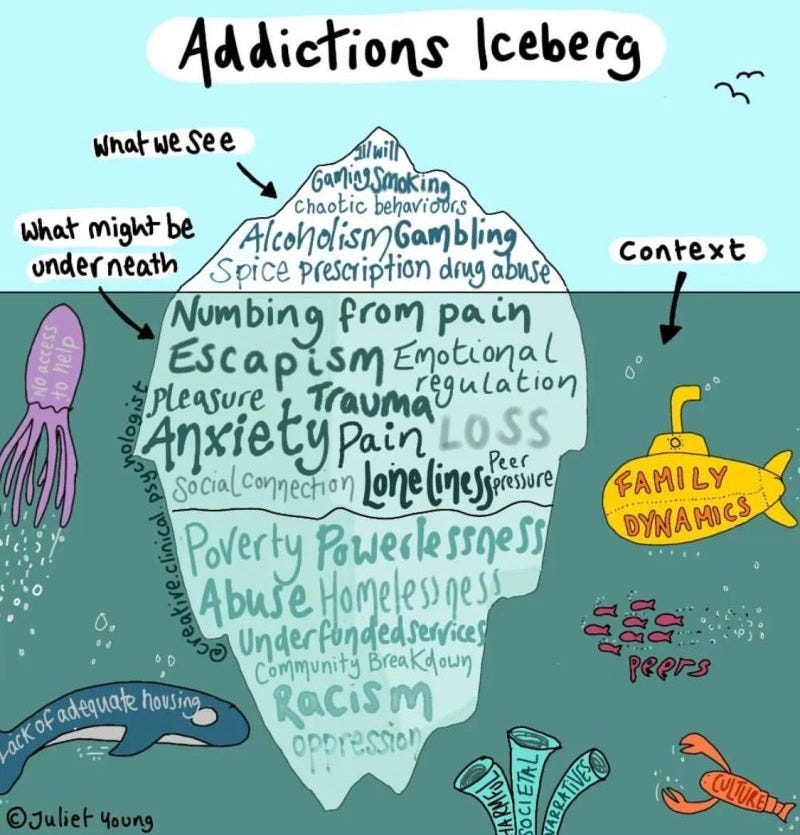
Cutting the substance out, is only the leading edge of what is possible. It is the thin first layer of the onion that exposes other parts of us to the light. Layers that have been buried (consciously or subconsciously) for all the shame they carry.
By being aware of your addiction and cutting it out, you are merely choosing to start feeling again. It is a vote for feeling versus numbing, but that is when the true game begins. And the cruel game of emotions involves waves of sadness, anger, resentment, and potentially the deepest forms of grief you will ever encounter.
And that’s when the devil will play her best trick on thee.
When the shame you were hiding bubbles up, the mirror can easily push you back into a cocoon of isolation.
That is when addiction really does a big number on you. That is when relapse is very likely to happen.
If the devil’s best trick was to convince you she did not exist,
then addiction’s best trick is convincing you that you can overcome it on your own.
That being said…
Here Is My Research-Based Three-Pillar Process for Overcoming Addictive Behaviors (and how I run it on myself)
This process blends evidence from longitudinal studies and clinical trials on addiction alongside my own personal recovery plan across the three pillars of The Human Dash:
Inner Work – meaning, identity, and relationship with the addiction. It reduces shame and constructs a meaningful identity, which lowers the emotional drivers of relapse.
Habit & Behavioral Activation – routines, peer support, and monitoring substitutes. This provides structure, social support, and alternative coping strategies, addressing the behavioral and environmental drivers of addiction identified in longitudinal research.
Data & Self-Compassion – tracking shame, self‑compassion, and physical recovery. This creates feedback loops: self‑compassion and physiological data make recovery progress visible, interrupt shame cycles, and reinforce motivation, supporting maintenance over time.
Together, these pillars operationalize the biopsychosocial model of addiction and the evidence that combined psychosocial and self‑monitoring approaches yield the most robust outcomes.
This is the exact spine of The Human Dash — the same three pillars I coach clients through, applied here to my own smoke and to the screen habits now creeping in to replace it. Each point pairs the evidence with how I actually live it.
You’ll find the research for each point below, followed by my own implementation of it in my journey to overcome smoking and have a healthier relationship with cannabis.
I also include a worksheet that you can use to implement it on your own.
These research and implementation segments are for Paid readers. You can try one out for free, and if you like these please consider a subscription!
